Pnumbral Raincoast & Dance Construction Company
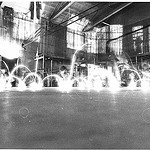
Washington Project for the Arts _ 1227 G Street NW Washington, DC
(1975) Experimental Evening – Dance/Music Improvisation, Feb 27 & 28, Washington Project for the Arts, 1227 G Street NW, Washington, DC.
Pnumbral Raincoast & Dance Construction Company
Dance and Music Event
Program
Listening Out Loud (See comments by John Driscoll, below)
Music by John Driscoll Steve Bloom, Phil Edelstein
Wild Song
Based on Coyote Song “a Navajo chant,” Julie Schwartz (Thursday only)
Homespun
Dance by John Bailey; Music by Julie Schwartz with John Driscoll, Steve Bloom, Dee Kohanna, Marlene Elbin
NOMESPUS (Friday, only)
Music by Julie Schwartz with Steve Bloom, John Driscoll, Dee Kohanna, Marlene Elbin
Intermission
GOT Light / White on Wings
Directed by John Bailey, Dance
Music by Steve Bloom, John Driscoll, Julie Schwartz, and Phil Edelstein
Dance by Brook Andrews, John Bailey, Betty Tittsworth, Maida Withers
DANCE and MUSIC
PNUMBRAL RAINCOAST is a contemporary performance group. The members are involved with various aspects of performance including technology, homemade instruments, improvisation, composition, and design for performance events. The present members are John Driscoll, Julie Schwartz, Phil Edelstein, and Steve Bloom (1974).
DANCE CONSTRUCTION COMPANY is a group of Washington based dancers whose primary focus is the construction of events and performances for realization of a total work unique to each setting. Improvisation and scripting, as well as choreography, are integrated by the group in their compositional structures. The company also performs repertory works. Maida Withers is the founder and director of the company. The current members are Brook Andrews, John Bailey, Liz Lerman, JoAnn Sellars, Betty Tittsworth, and Maida Withers (1974).
Comments below by John Driscoll:
LISTENING OUT LOUD (1974) is composed by John Driscoll for performance with the members of Pnumbral Raincoast. It utilizes an ensemble with parts for live electronics, rip saw, crosscut saw, microphone goosenecks, tape, and voice. The electronics control the volume and pitch of previously recorded saw material, which is simultaneously mixed back in with the live sound of the saws and goosenecks. The saws not only produce tones in the space, but also serve as a source of control signals for use with the electronics. The saws not only produce tones in the space, but also serve as a source of control signals for use with the electronics. The saws are bowed in order to produce various glissandi, sustained pitches,, and tone bursts. These are complimented by a choral effect produced by the tape and electronics.
Due to the phase shift of the pitches played on the saws, being mixed with the sound of the goosenecks, there are moments in the piece where the listener loses his or her sense of the location of the pitches. This sonic effect is heightened by a resonant space, to the point where the reverberation of the space becomes an integral part of “Listening Out Loud.” This work also has versions for solo and duet performance.
BOG WORKS (1975) is a solo live electronic work, composed and performed by John Driscoll. The piece uses a number of specially constructed resonant loudspeakers, four conventional loudspeakers, and a number of custom made electronic modules, built for this piece. The sculptural loudspeakers are made from fiber tubes, a curved plastic tube, a long rectangular mahogany box, and a large diameter shallow stainless steel dish. All these loudspeakers are activated by a large variety of audio drivers.
Since each of these speakers only pass a narrow band of pitches, due to their construction, the sound is distributed into different speakers depending upon the pitch of the signal. This particular characteristic makes it possible for sounds to be moved rapidly around the space with a minimum of manual manipulation. “Bod Works” is based on one tape recording of frogs, which has been acoustically and electronically transformed; in order to develop other generations of source material. These tapes are played on digital speed controlled cassette machines, which change speed in relation to the amplitude or frequency of their own signal. These signals are then taken and fed simultaneously into both the resonant and conventional loudspeakers. The result of this is a dense, rapidly changing, sonic environment about forty minutes long.
Artists and Collaborators
- Sound/Music Artists
- Dance Artists
- Publicity Flyer